
Mind mapping is a simple technique for visually organizing information in to diagrams, instead of writing it in sentences.
The idea behind mind maps is using words and images to create strong associations that help you remember what you're studying.
It's proven that having clear mental images speeds up and improves the quality of the learning process.
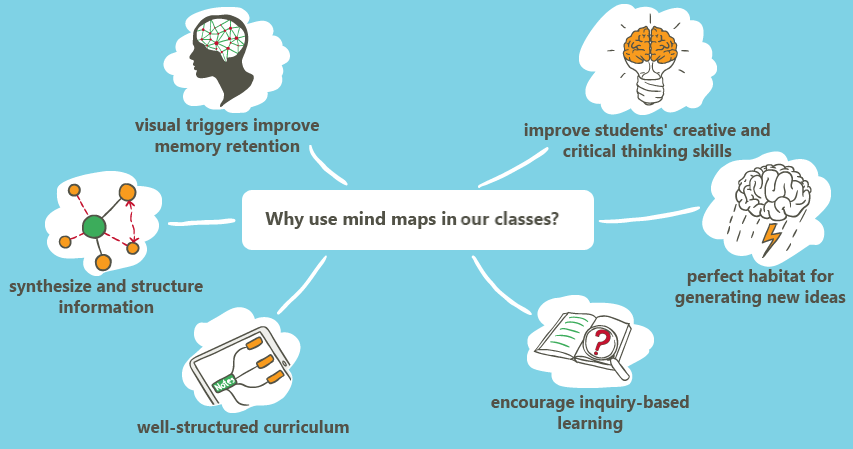
The flexible nature of the maps allows you to draw links between ideas in a web shape.
As your knowledge of the concepts becomes clearer and deeper, the web can then be adapted.
For the web to one day become a masterpiece, it will be messy at times.
It needs all our experience and creativity to find the path that will bring you to your goal.
We want to move you away from linear learning to something more effective and congruent with the intensity of our program : Meaningful Learning.
Meaningful Learning means having a clear comprehension of new information which you can then associate with ideas you already had.
In doing so, we will create a far deeper understanding of what we are trying to achieve.
Obviously as your instructors, we benefit from having the content synthetized.
But how can we be even more efficient?
Collaboration.
It is vital that you take part in the evolution of your mind map.
By participating actively, you will help us clarify misunderstandings you have along the way.
With a little time and your input, we will take ownership of the new knowledge as a team.
There is a reason why we trust using the mind maps system so implicitly.
It has worked for our personal journeys as well as for all our clients around the world.
Let's get started on yours today.
Our mindmaps can be organised in different ways
First, Diagnosis leading to Treatment branches.
1 What you already do well
2 The areas of potential gains
3 Describing the current issue
4 Drawing hypothesis to solve it
5 Analyzing what the best options are
6 Getting as specific as possible on HOW to solve the issue : text explanations, 3d reprensentation, photos, videos, analogies, drills. The more the better
7 Making sure it doesn't create new problems
8 Repeating and updating as more and more solutions are found
Beyond this, the timeline-based branches which will analyze each phase of your swing from Adress to Finish.
1 Setup
2 Backswing
3 Transition
4 Release
Yes, we believe the swing has 3 phases, not 2.
The club may experience a backswing and a downswing, but very few body movements follow that 1-2 approach.
There is a dynamicness to the whole sequence that adds another step.
Lastly, View-specific branches where we are more focused on what you should see from different angles.
Helps with mental imagery and creating a 3d vision of what your swing could look like if you implement the changes.
1 Face on
2 DTL
3 Backview
4 Any other view that may help you ingrain a movement better
Copyright © 2026 RED PILL GOLF.
All rights reserved.